Log is an eco-friendly building material
Wood is a renewable natural resource and, in fact, the only building material whose legal origin and sustainable production can be certified. Throughout their entire life cycle, timber houses cause significantly less climate and environmental harm than equivalent concrete, steel or brick houses. Thus, the use of timber in construction helps to mitigate climate change.
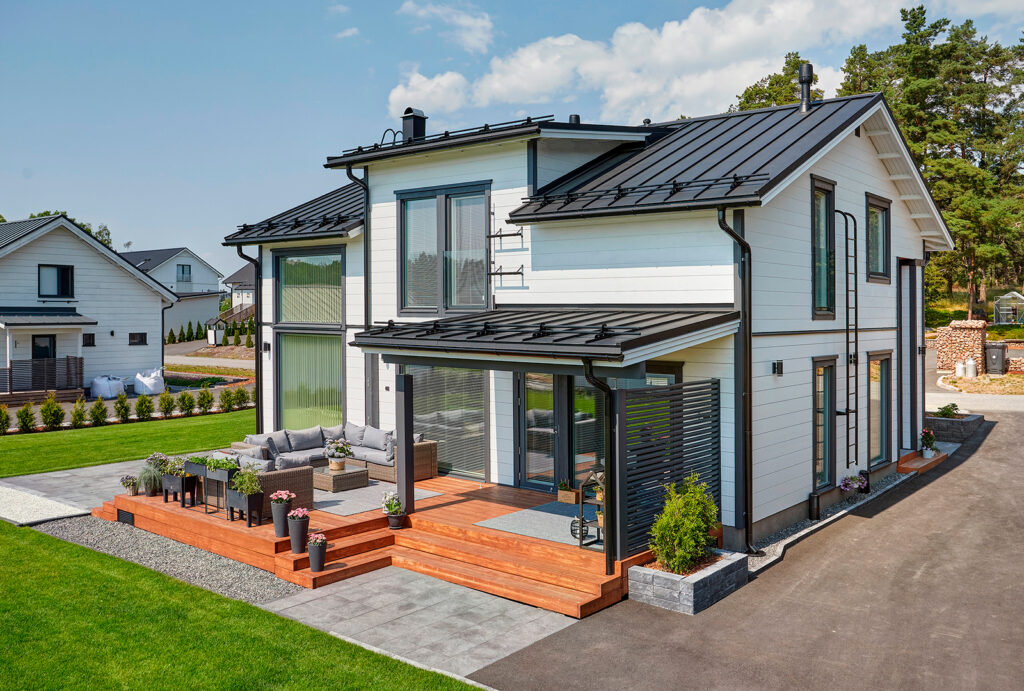
Log timber is durable and ecological, making it ideal for detached homes, holiday homes and public buildings alike. A log wall sequesters ten times as much carbon as is released during its manufacture, and the sawdust and wood chips produced as by-products of log production generate more energy than is consumed in the manufacturing process.
A log house is long-lasting and eco-friendly even when lived in. A log wall reduces the need for heating and cooling, as the logs even out temperature differences within the building – it stays warm in winter, whilst the breathable structure keeps the indoor air pleasantly cool in summer. The durability of the timber used has been tested in Finland’s harsh climatic conditions, including drought, rain and winter frosts.
In addition to being an ecological material, log has other advantages such as breathability and moisture safety, durability, hypoallergenic properties, excellent indoor air quality and health benefits, as well as being natural.
Log homes have excellent indoor air quality
Numerous studies have confirmed that log homes are allergy-friendly thanks to their excellent indoor air quality! The good air quality in log homes is based on the wood’s ability to absorb and release moisture into and from the walls. In other words, the log surfaces absorb moisture when indoor humidity rises and release it when the air dries out. This reduces fluctuations in indoor humidity and improves air quality. The small cracks on the surface of the wood also play a role. They increase the surface area through which the wood absorbs moisture and then releases it again.
A solid log wall without additional insulation contains no floors in which moisture could condense within the wall structure. According to studies, laminated log walls (alongside solid log walls) also perform reliably in terms of moisture management in both summer heat and freezing conditions, as the glue joints allow water vapour to pass through when necessary. Building a log house or log holiday home is therefore a safe choice in terms of moisture management.
Furthermore, the atmosphere in a log house or holiday home is relaxed and calming. Research has shown that wooden surfaces promote healing, reduce stress and improve mood. Studies have also shown that wooden surfaces indoors calm the body, lower blood pressure and reduce heart rate. As a building material, wood is warm, cosy and soothing.