During our initial planning meeting, an architect we know remarked that a house should never be a compromise. Our house has really been nothing more than a series of compromises, but fortunately my husband and I have always been in complete agreement on this point.
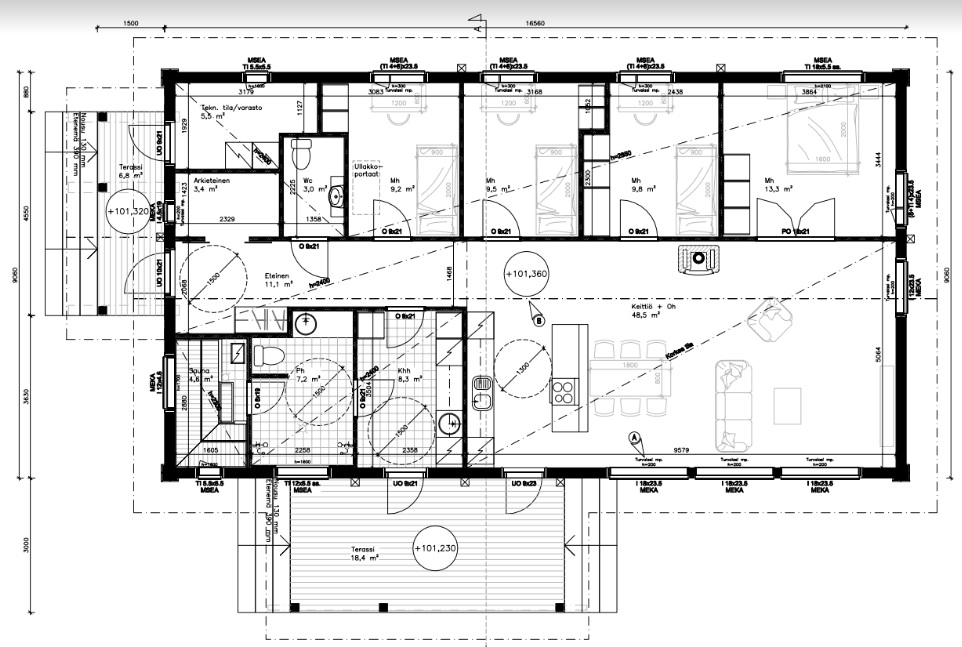
Naturally, we started the design process by considering the shape of the plot and the layout of the buildings, our family’s needs, and some great tips and floor plans from Instagram. My ‘must-haves’ were: a fairly large open-plan living room and kitchen with a view of the lake through large windows, four bedrooms, a good-sized sauna, and access from the utility room and sauna facilities to a terrace that also opens out onto the lake. My husband’s must-haves were: underfloor heating, a carport for two cars, a covered terrace and an attic where we could check the insulation. The children’s list included their own rooms and a hot tub. Then there were various ‘nice-to-haves’, such as a kitchen island, a sloping ceiling, a black fireplace, an island in the kitchen and double doors to the master bedroom. You can guess who came up with those last few wishes.
For us, the design and planning of the building has progressed along two axes: one being health and safety, and the other being appearance. Of course, the functionality of the house to meet our needs has been the starting point for everything. There are also limiting factors, such as the shape of the plot and the available budget. One of these has already been stretched somewhat, whilst the other has not. Not all our choices have necessarily been based on facts; there have also been many emotionally driven decisions.
Laminated log, a gable roof and decent windows
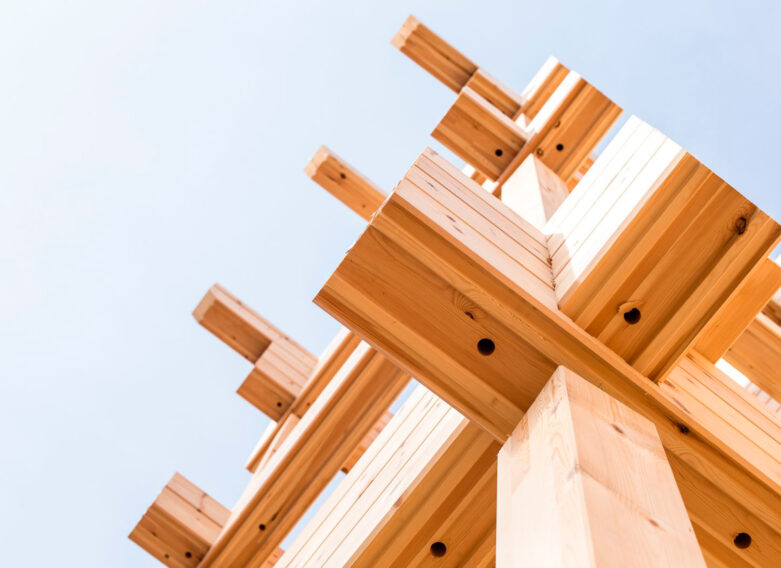
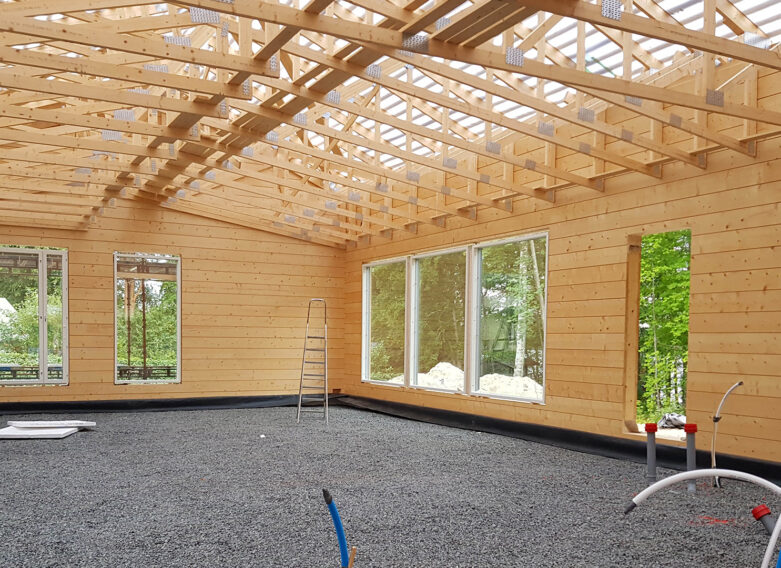
Choosing the logs was one of the very first decisions we had to make. We received quotes for several different log options from our Kuusamo Representative and eventually settled on 23 cm thick modern spruce laminated logs. Our supplier informed us that the settlement of so-called ‘non-settling’ laminated logs is not particularly significant in Kuusamo, but it does affect the appearance of the windows to some extent, as a settlement allowance must be left above the window, which is then covered with cladding boards. The natural settling of the logs must also be taken into account in partition walls, which means allowing for settlement gaps.
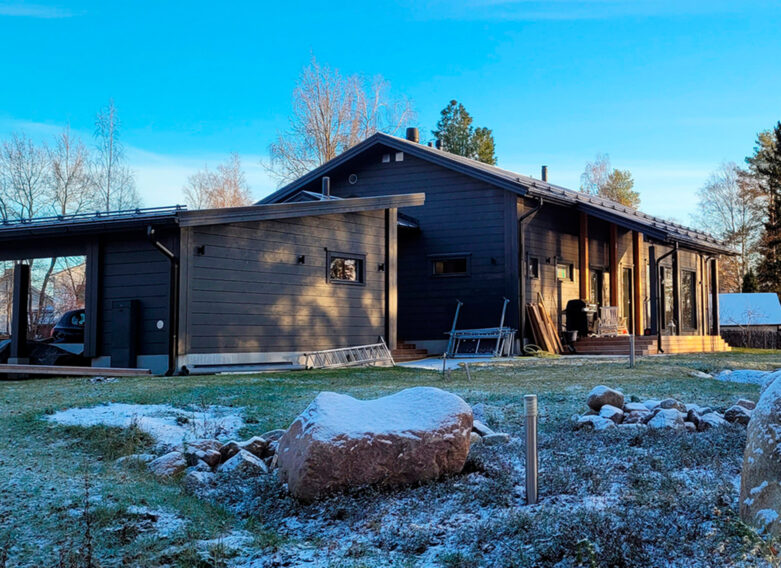
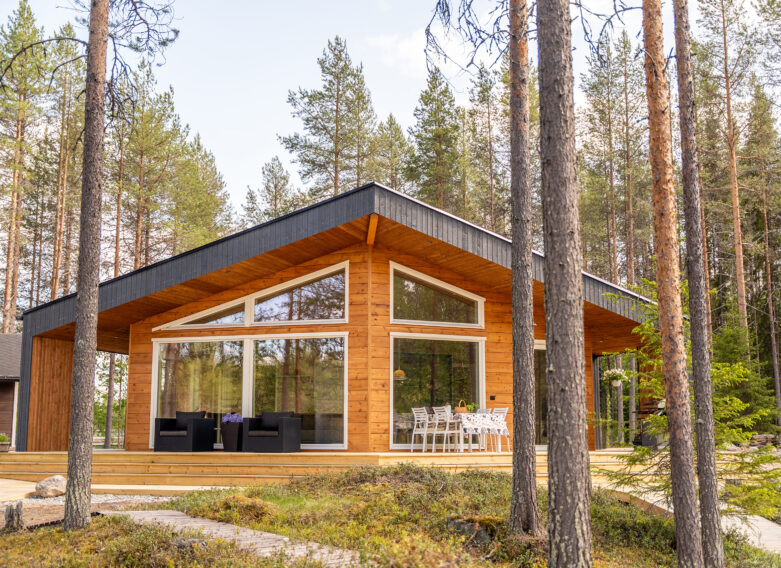
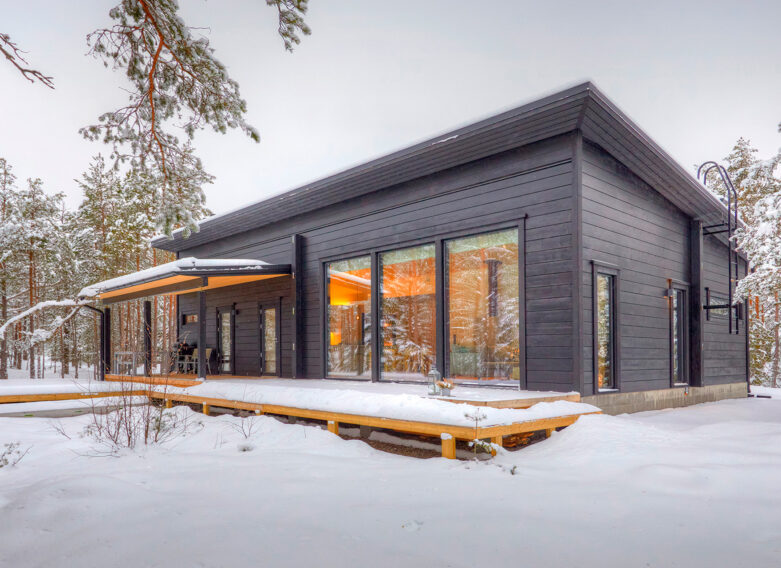
We had quite a few discussions about the shape of the roof. In the end, we chose a gable roof, as we felt it would be good to provide some protection for the house walls from the wind and rain coming from the direction of the lake. A single-pitched roof would have suited the plot perfectly, but here too, something felt right about a traditional gable roof. On the other hand, a covered terrace was also convenient to build under the extended gable roof.
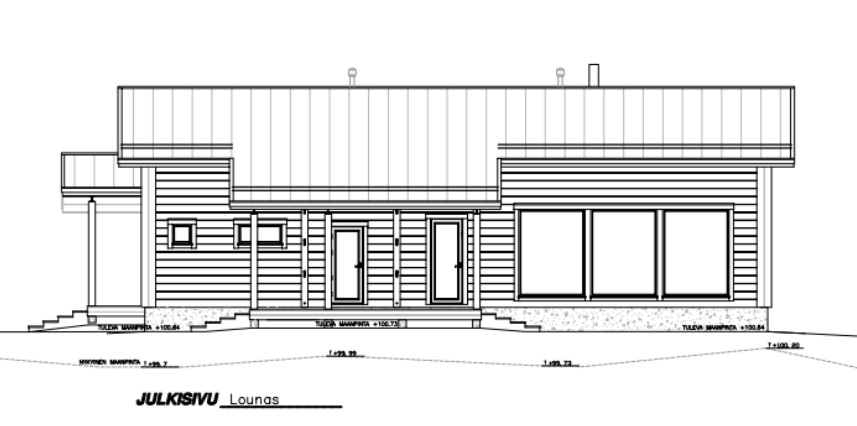
Another compromise worth mentioning is the windows. My preference would have been for grand floor-to-ceiling windows facing the park and the lake, ideally spanning the entire width of the wall. However, after consulting with the carpenters, it felt safer to leave a bit of timber beneath and to the sides of the windows in a log house to support and protect them.
By the time these decisions were made, at least a year had passed, and in the meantime we’d gone through dozens of sheets of graph paper; my husband had learnt to use a free online CAD programme, and I, for my part, had already searched for ‘log house’ and found a thousand images. What’s more, the children had already asked several times whether they would ever get to choose the colour of the walls in their own rooms.
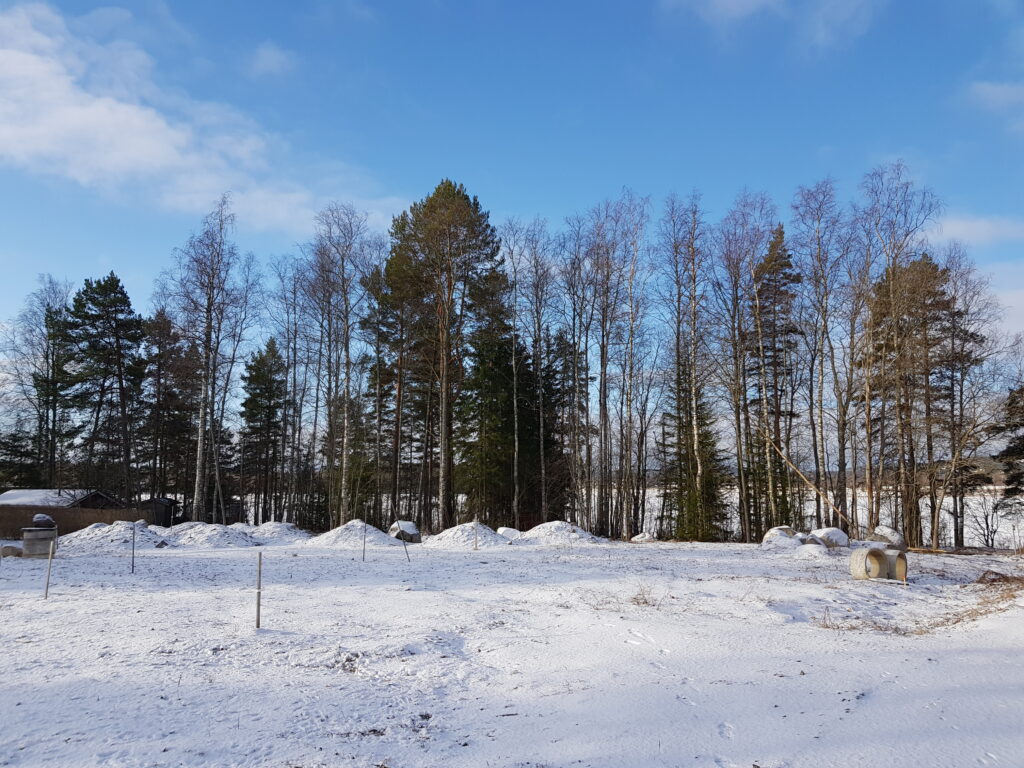
Things certainly got busy
Although design and planning began well in advance of the project’s launch, it felt as though spring was fast approaching and the permits and contracts were still only half-way through. To obtain a building permit, we had to consult 11 neighbours, as this included a couple of estates, some of whose members lived in another town.
In our town, obtaining the permit went relatively smoothly, even though preliminary information suggested there was a backlog in permit processing. So my tip here is that you should start applying for permits and ordering the house well in advance, and begin design and planning long before that. And speaking of well in advance, it would be best to have the house ordered about six months before the excavator is due to arrive on site. We signed the supply contract in January and the excavator started work on the site in mid-May. Of course, design and planning had been underway for a long time before the contracts were signed.
My husband has been in charge of the planning permission matters and has, in practice, handled all the checks and details relating to the plans. He clearly has a better understanding of the technical aspects than I do, whilst I believe I have a better eye for aesthetic matters. But these things go hand in hand! For example, there’s no point in designing a beautiful and functional kitchen island without properly positioned electrical sockets and a cooker hood, so it’s best to stay in close communication throughout the project. And yet, no matter how hard you try, the words that come out aren’t always the most beautiful, nor are they spoken in the most melodious tone.
We have several plans. First, we drew up a site plan showing the placement of the buildings on the plot; of course, at that stage we already had to know what sort of house we wanted. An architect we know drew up the site plan, floor plan and elevation drawings for us based on our own ideas. She acted mainly as a sounding board and a critical thinker for our ideas. She gave us some good suggestions for changes, for example to the house’s entrance and façades, as well as to some of the room layouts. We also received a great deal of help and advice on design and planning from our Kuusamo Representative, Jaakko. My husband also spent countless hours sketching the house in advance, sometimes on the computer and sometimes with the children in the form of a gingerbread house, and each time the plans improved.
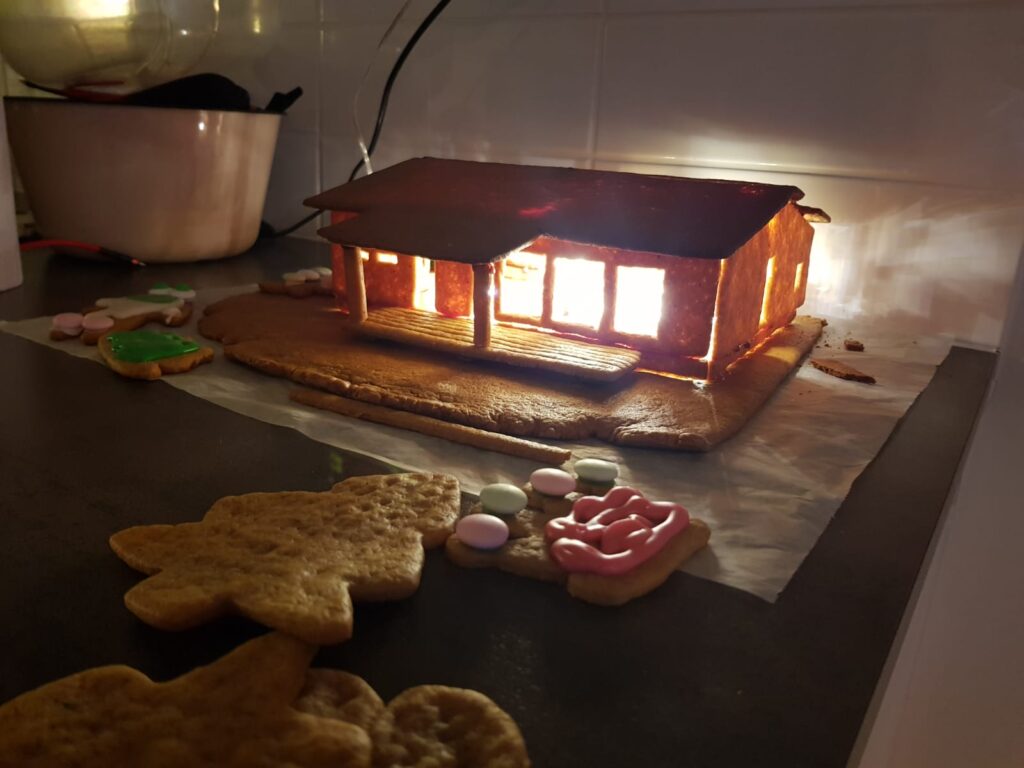
Well planned is half done
The design and planning process began with a ground survey, which was used to assess the house’s foundation method. The building permit drawings were included in the Kuusamo Log Houses house package and were created based on ideas developed jointly by the architect and us. In addition, we needed a site plan, an electrical plan, HVAC drawings, a foundation plan and a garden plan; the latter is probably not mandatory, but it does make earthworks and site planning easier, amongst other things. There is also a separate window and door plan.
We went through at least half a dozen rounds of checks and minor changes for each plan, as not all changes occur to you at once; instead, they tend to pop into your head at around 5 am. The first thing in the morning, the phone rings at Kaisa’s – that is, the architecht’s – office, kicking off a new round of revisions. Still, I’d say that well planned is half done. Someone once said that financially significant decisions are made at the drawing board, and that’s certainly true.
Spring came, the snow melted, the digger went vroom-vroom
One day, a carpenters’ site hut appeared at the edge of the plot, then the excavator arrived – not Rolle, but Jussi. And then the earth began to shift as Jussi swung the levers in the excavator’s cab and the lorries drove back and forth. I contented myself with watching the goings-on from the edge of the plot and reminding the builders to use sufficient sun protection. Quickly, those skilled builders conjured up fine, neat foundations for a perfectly good compromise house, which is also known as the Log House Kultsi.
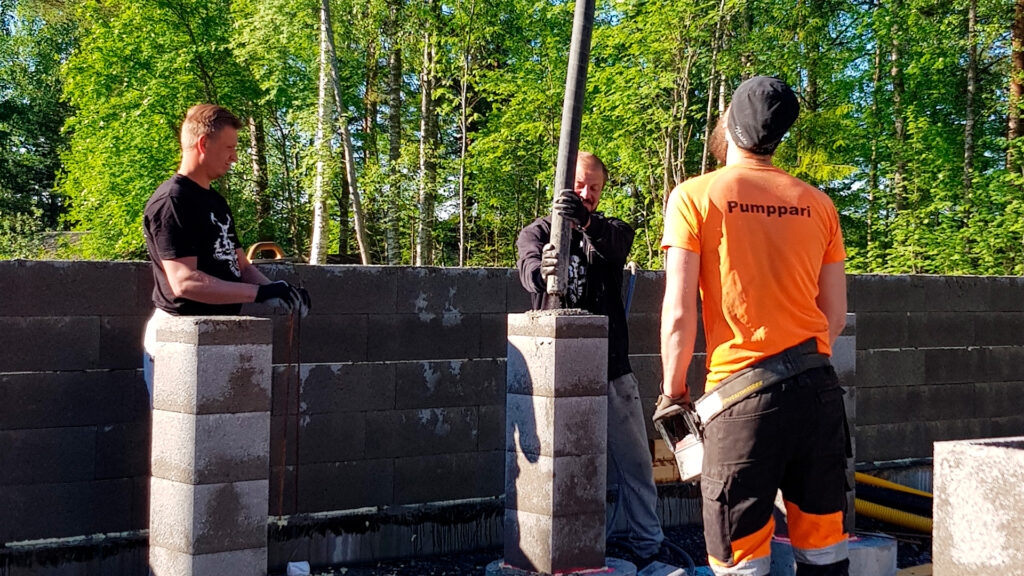
Taija
The family is building a modern log house by Kuusamo Log Houses in Central Finland based on their own plans. Blog posts are published on the various stages of construction. You can also follow the build on Instagram.
Read Taija’s other blogs
-
Guest article
-
Guest article
-
Guest article
-
Guest article