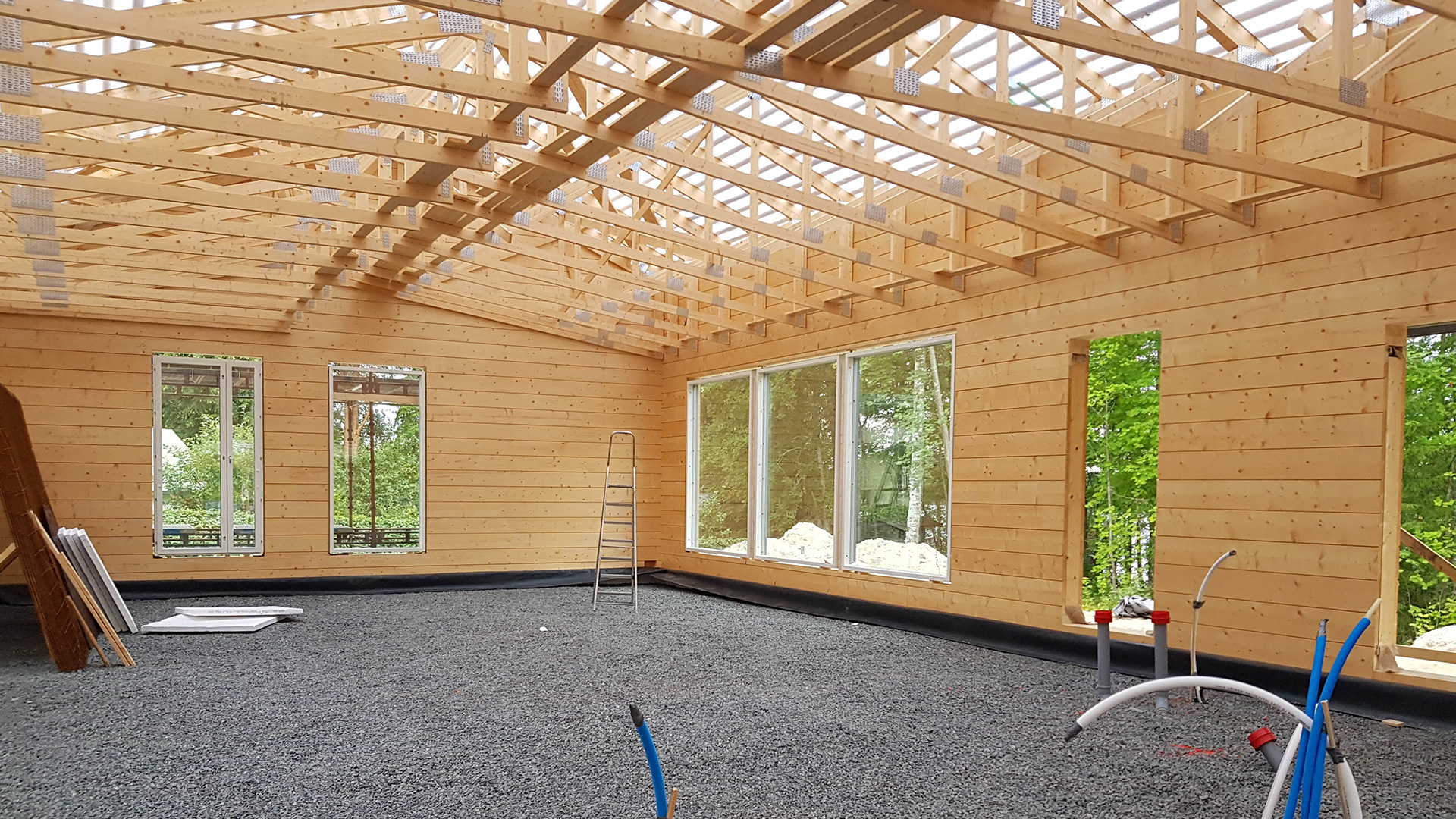
Log Construction
Log construction is a project involving many stages. Once the initial design and planning, paperwork and other preparatory tasks have been completed, it is time to roll up your sleeves and start building the house. This blog series follows a modern log house construction project from the client’s perspective. The first part of the series explores why a log house was the only right solution. The second part delves into the design process for a log house, and this third part looks at log construction in practice. The story continues in the fourth part of the blog series, when the interior work on the log house begins.
Log construction begins when the log packages arrive on site
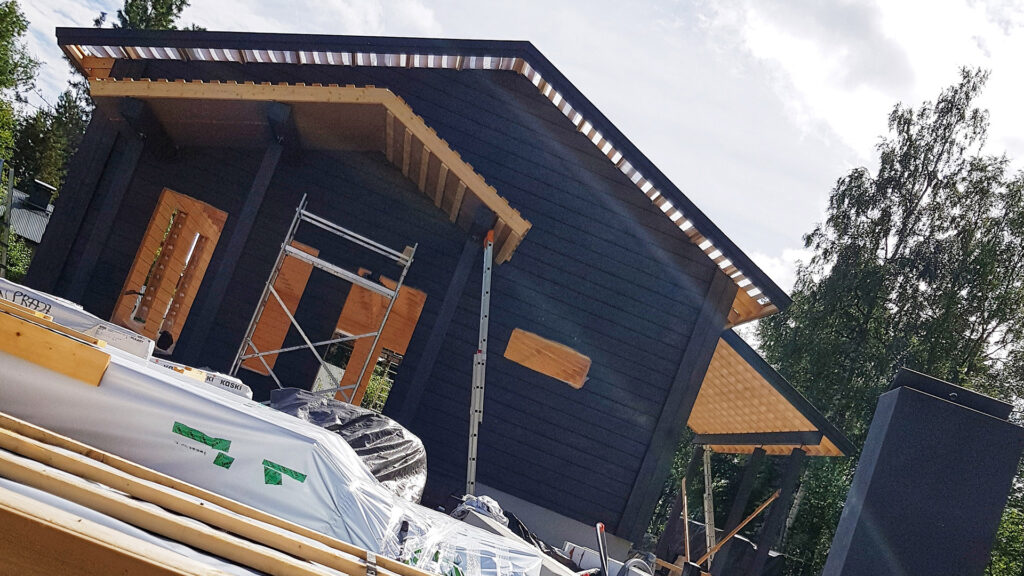
– I’m setting off from here in Kuusamo, so I should be at the site around midday tomorrow, a cheerful lorry driver phoned us in early July, after the logs for the main building of the Log House Kultsi had been loaded at the Kuusamo Log Houses factory. Before that, we’d done some preparatory work on the site, such as collecting surplus pallets from hardware stores to place the log bundles on. In addition, some extra crushed stone had been brought onto the site to ensure the logs had a firm and dry base until they were erected. We had also reserved about ten large tarpaulins for protection.
A tear did well up when the Kuusamo Log Houses lorry turned into the plot under the blazing July sun – we had waited, hoped for and planned our house for so long. There wasn’t much time for tears, though, as we had to start unloading the load straight away to help the driver. There was plenty of space on our plot, but even so, it felt like it took quite a bit of fiddling to arrange the long bundles of logs. There was enough material to fill a 27-metre-long full trailer. In addition to the logs, the load included roof trusses, flax insulation, timber and wool, amounting to well over a hundred cubic metres. We also knew that the materials for the carports were due to be delivered the following week. So we had to play a bit of Tetris with the log bundles to get the goods neatly arranged on the site, and of course we managed it.
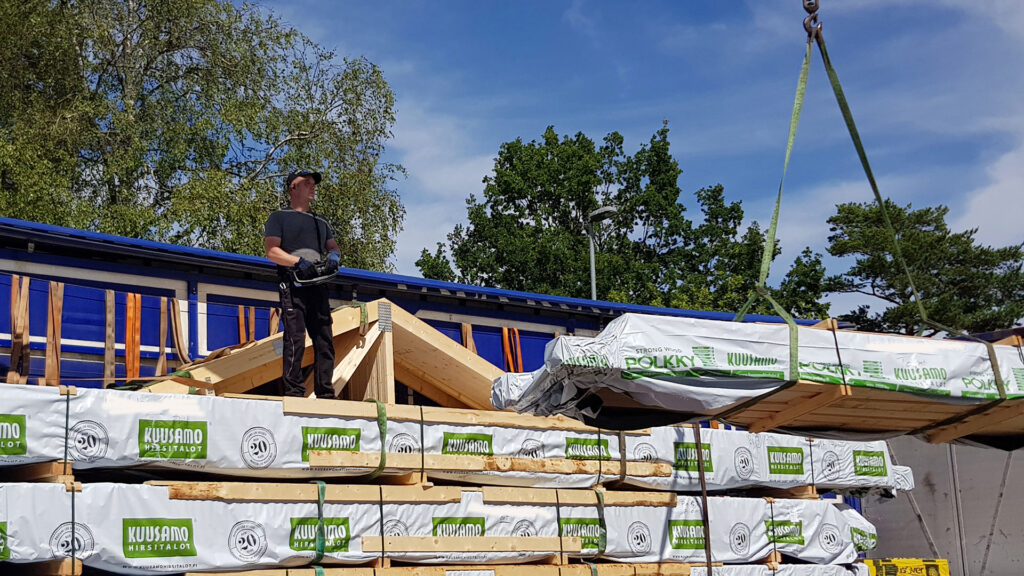
Log construction using natural materials – beautiful wood and flax for insulation
We knew what to expect with our log house, but I must admit my heart skipped a beat when we opened the log bundles and saw the beautiful, light-coloured planed spruce logs peeking out. The scent was lovely too. Not at all overpowering; the logs had a really mild, clean woody scent. And all those wood grain patterns in the logs certainly pleased both our eyes. The flax to be used as insulation, on the other hand, had a slightly peculiar ‘sheep-like’ smell, but even that faded away as the flax was installed between the logs.
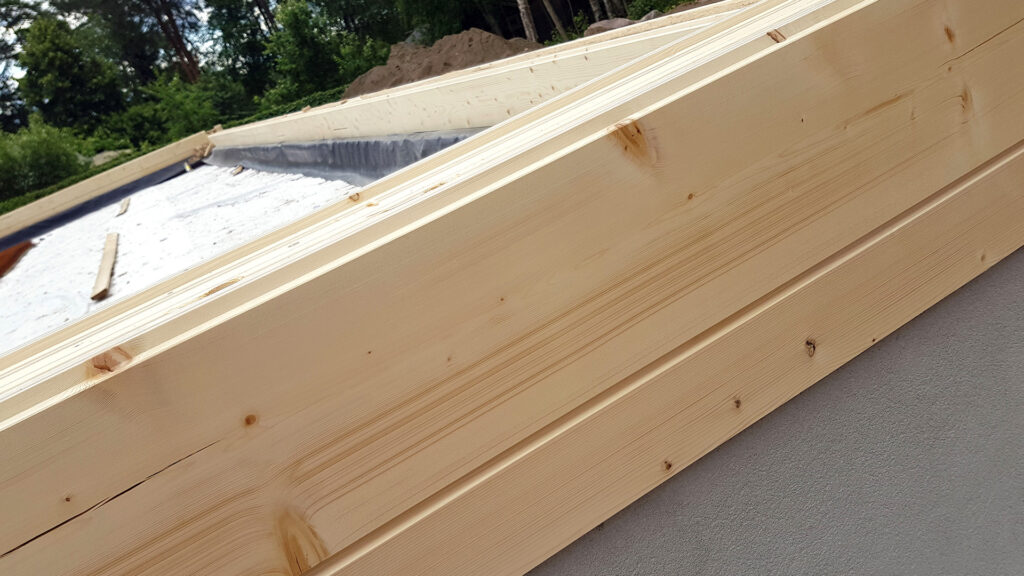
Log construction goes smoothly in good weather
In our case, the weather was absolutely perfect for log construction. The delivery of the logs and the erection of the frame went smoothly, as the sun shone from a clear sky for a solid four weeks. Even for our experienced carpenters, this was the first rain-free erection of its kind, as there was practically no rain at all during the process.
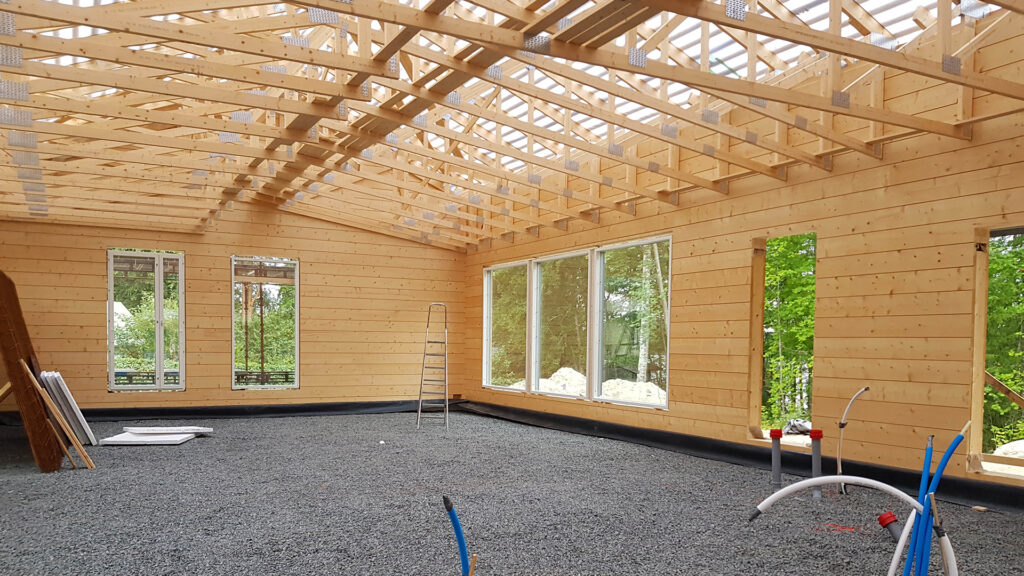
It took about a week to assemble the log frame. Within two weeks, the underlay was in place and the frame was fully protected from the rain. The open window sills were covered with plastic to prevent any rain from getting in and wetting the logs. At the end of the erection days, we covered the upper parts of the frame with plastic.
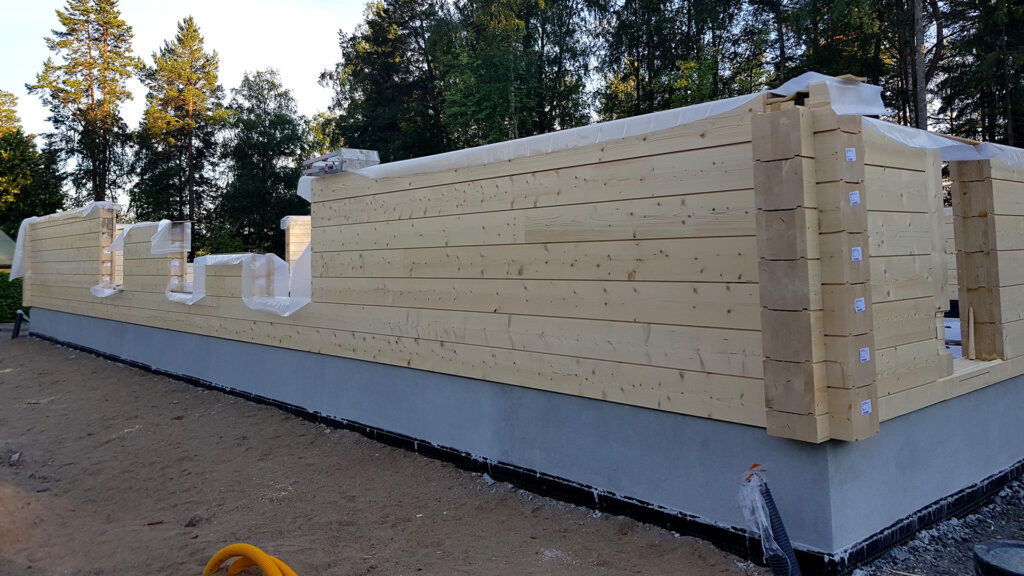
We had commissioned Aki Hakovirta from Tampere to carry out the ‘weather-protected’ erection as a contract. The weather certainly didn’t pose any challenges. The only factor that presented challenges during construction was the coronavirus. Our first erector had to cease trading due to the pandemic, and so the erection we’d booked for the best weeks of July was cancelled in May. Fortunately, we managed to arrange the erection for the desired weeks with a new team. Here too, our log house sales representative Jaakko helped us out.
Log construction with a partial assembly
We were really pleased with the erection and the builders. We were assigned experienced carpenters, with whom my husband was able to help build the cottage. My husband was on site practically throughout the entire erection process, and he had actually timed his summer holiday to coincide with the erection period. Personally, I think that even if you opt for a ‘turnkey’ construction service, it’s still a good idea for the owner to be available and, ideally, even on site as much as possible during the build. This way, you can discuss decisions made during the build and, at the same time, stay best informed about how your own house has ‘taken shape’ during the construction process.
It is also worth remembering that, if any uncertainties arise, the final decisions regarding the house always rest with the owner. They have the authority and responsibility, not least from the perspective of the money invested in the house. Of course, it is always worth listening to and valuing log construction experts, such as a good site foreman and skilled carpenters. However, they often have many similar projects under their belt, so log construction is familiar to them, whereas for the homeowner the situation may be a one-off. Another piece of good advice is to ‘seek a second opinion’ should any disagreements arise. After all, every building project encounters them, whether you like it or not. That is why a wide network of construction experts is worth its weight in gold at this stage. Often, tips and advice can be obtained over a cup of coffee or with a friendly thank you – you just have to ask, and I certainly have!
At the very least, the owner should make arrangements for receiving the goods and for protecting the frame and any other items arriving on site. Admittedly, our protection ideas were a bit over the top, as we didn’t want the logs to get wet during stacking. My husband devised some unpatented solutions, including ways to protect the high gables of the house during the (completely clear) nights.
Start the chainsaw and hide the log corners
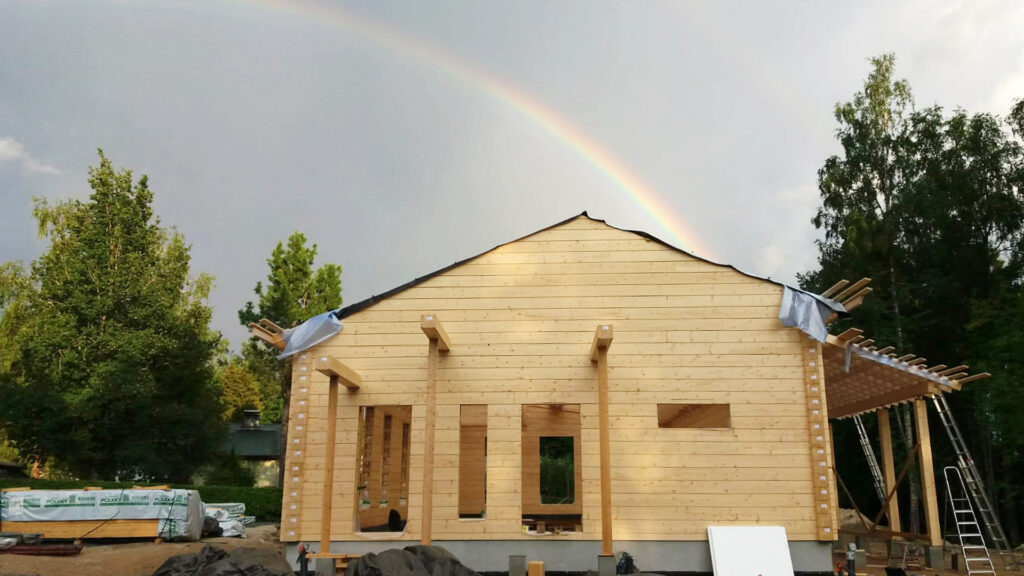
We wanted our log house to have enclosed corners. The local planning regulations for our residential area stipulated that a log house could be built either with a 0-degree corner or a short cross corner joint. We opted for a short log corner, as we felt that a log house should, so to speak, be built with a traditional cross corner joint, even if it was a short one. We also decided to clad the corners with boards, under which we laid bitumen paper, which seemed like a good solution for moisture protection. Of course, we obtained the instructions for making the cladding from Kuusamo Log Houses.
The ‘interesting part’ of the short cross corner joint was the finishing work that had to be done on site. My husband did it with a chainsaw. A short cross corner joint is made from a standard-length cross corner joint. The corner is deliberately left longer, as a long joint is less susceptible to damage during woodworking, transport or installation. Only after the structure has been erected are the corners shortened and encased. My husband made the corner boards and fitted them in place. This was perhaps a slightly too nerve-wracking stage for me, even though my husband has certainly proved himself to be quite a skilled carpenter during the construction project, if not before.
In hindsight, sheered corner joint or 90-degree corners wouldn’t have required any DIY work at all, which would have meant a much lighter workload and a few less heart-stopping moments. But never mind, as the result was top-notch, even though we were only aiming for average.
Log construction is progressing rapidly – the metal roof was erected in four weeks
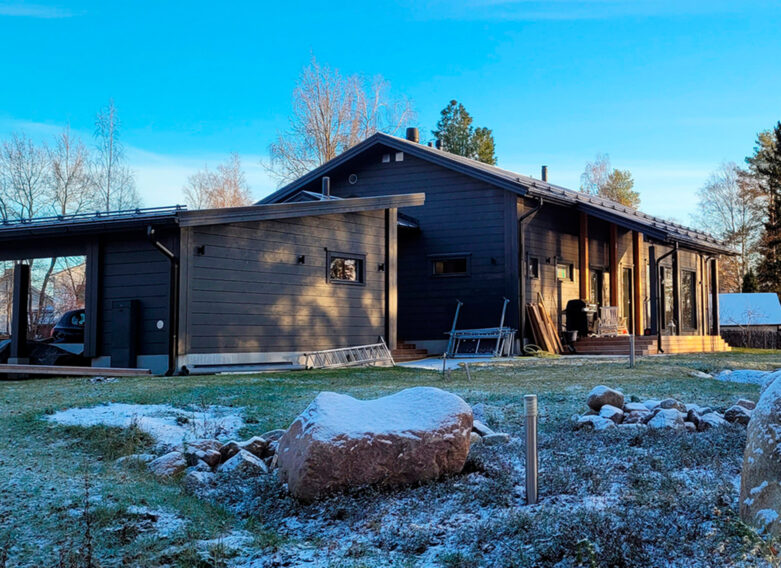
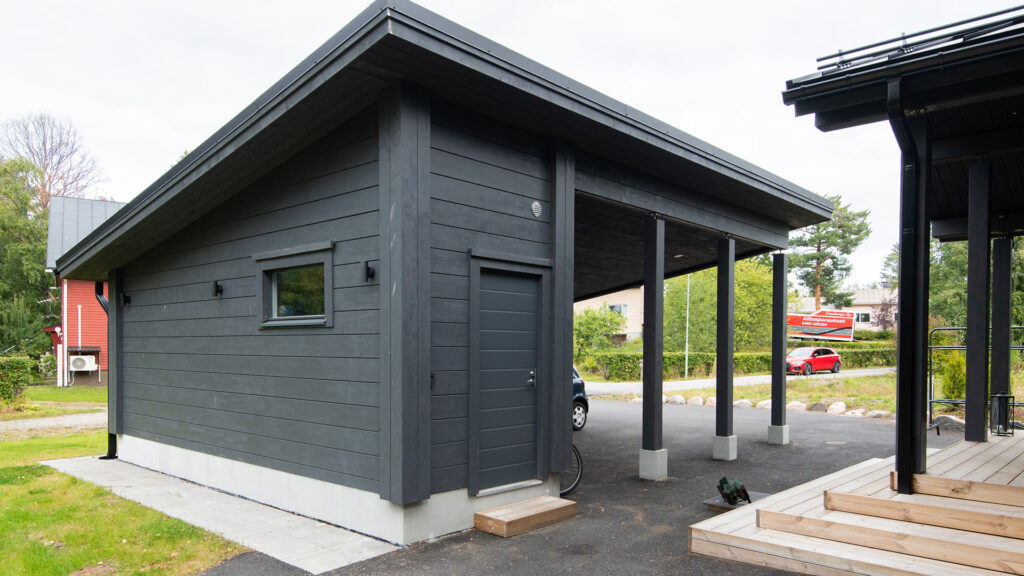
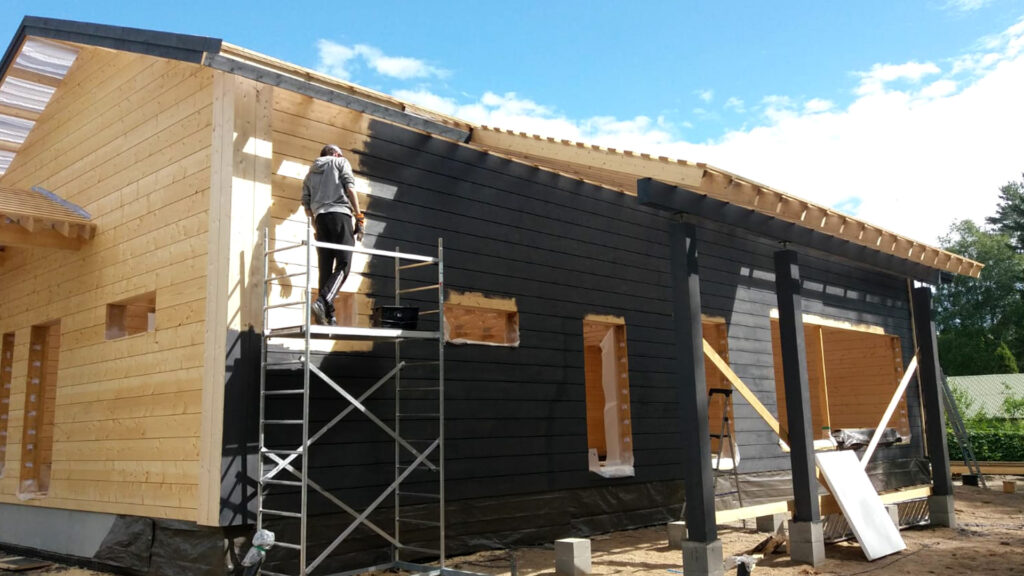
At its best, log construction is a faster project than one might initially think. Within four weeks of starting the erection of our log house, both the main building and the carport had been erected and the tin roof installed. We had also included the fixing of the eaves boards in the erection contract. The whole family, including grandma and grandpa, took part in the painting of the eaves boards over about five days of the summer holidays. We used about a kilometre of eaves boards for our house and the carport. That left several hundred metres for my parents to paint, a couple of hundred metres for my daughter, and the rest for the rest of us. We painted the house shortly after it was erected using Virtanen’s four-oil paint, as we wanted a traditional, breathable oil-based paint for the log house. Fortunately, we were joined in the log house painting efforts by my good friend’s son, who turned out to be quite a handy painter. Before painting, my husband had treated all the exterior surfaces with a mould inhibitor.
It’s beautiful, and it’s ours
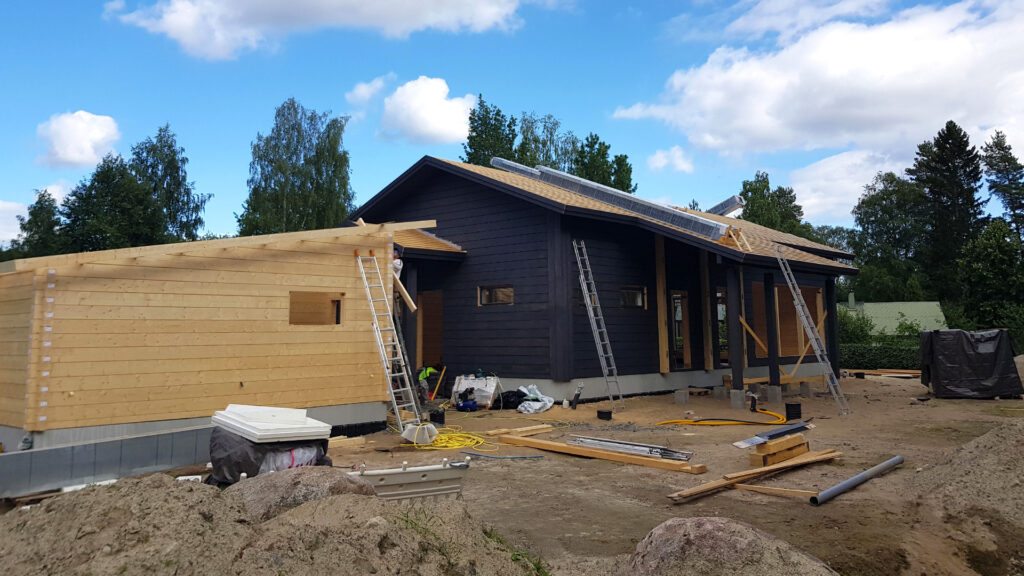
Log construction certainly kept us busy with small and large construction tasks throughout the middle of summer, and there’s plenty more to come in the autumn and winter too. We previously had one house built on a so-called ‘turnkey’ basis, but with this second one we’ve been much more involved in the process ourselves. We’ve been involved in the design and planning, construction and finishing of the house, as well as taking charge of coordinating the whole project and all the contacts. I feel that this model has suited us well, even though it takes time and is a bit nerve-wracking. At least we won’t end up with the wrong keys, having had a hand in the mix ourselves. And it’s such a fascinating project to follow and be part of! I wouldn’t swap a single day for anything… or well, maybe I could swap a few. But still… it’s going to be a wonderful house, in fact much more wonderful than either of us could ever have dreamed of at the start.
Taija
The family is building a modern log house by Kuusamo Log Houses in Central Finland based on their own plans. Blog posts will be published on the various stages of the build. You can also follow the build on Instagram: @hirsitalo_kultsi.
Read Taija’s other blogs:
-
Guest article

-
Guest article
-
Guest article
-
Guest article